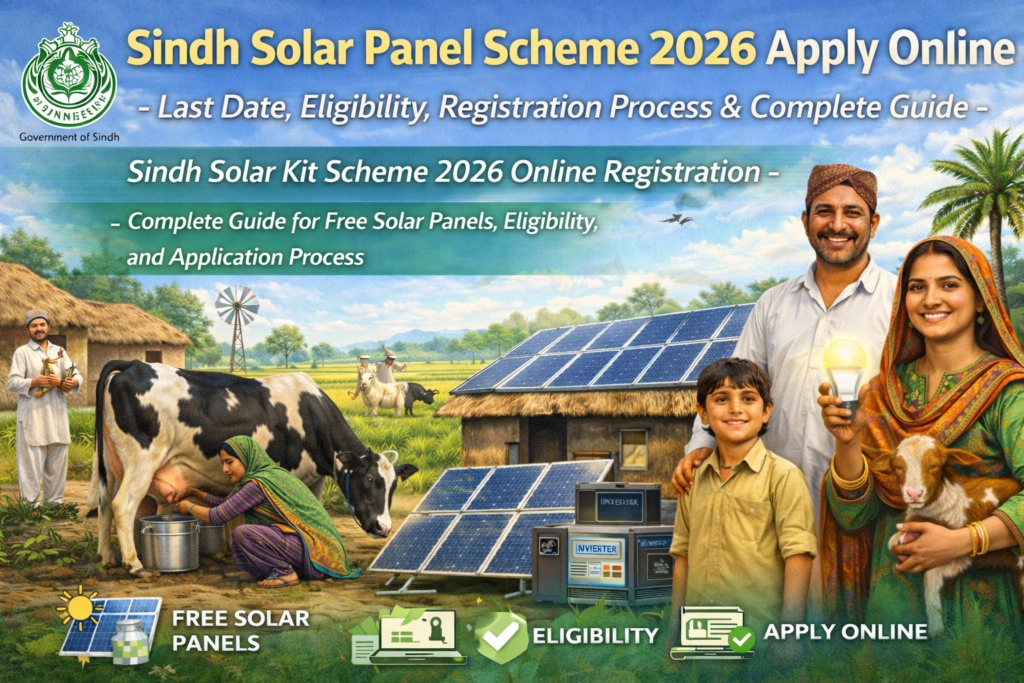
Sindh Solar Panel Scheme 2026 Apply Online – Last Date, Eligibility, Registration Process & Complete Guide The Sindh Solar Panel Scheme 2026 is an important renewable energy initiative introduced by the Government of Sindh to provide clean and affordable electricity to low-income households. Rising electricity costs and frequent power outages have made it difficult for many families, particularly in rural areas, to maintain a stable power supply.
To address this challenge, the provincial government has launched multiple solar programs under the Sindh Solar Energy Project (SSEP) and the Sindh Energy Department. These programs aim to distribute solar home systems to thousands of households who either consume minimal electricity or have no access to the national grid.
Many citizens are now searching for information about the Sindh Solar Panel Scheme apply online last date, eligibility criteria, and the application process. This detailed guide explains everything you need to know, including how to apply, who qualifies, and the benefits of the program.
Overview of the Sindh Solar Panel Scheme 2026
The Sindh Solar Panel Scheme is designed to promote renewable energy and provide electricity access to underserved communities. Through this initiative, the government plans to distribute solar systems to families who struggle to afford conventional electricity.
The scheme mainly focuses on low-income households and rural communities.
Key Program Details
| Feature | Details |
|---|---|
| Program Name | Sindh Solar Panel Scheme 2026 |
| Implementing Authority | Sindh Energy Department |
| Project Partner | Sindh Solar Energy Project (SSEP) |
| Target Beneficiaries | Low-income households |
| Electricity Consumption Limit | Less than 100 units per month |
| Solar System Components | Solar panel, battery, charge controller |
| Application Method | Online registration and field verification |
This initiative plays an important role in Sindh’s renewable energy strategy.
Sindh Solar Panel Scheme Apply Online Last Date
Many applicants are searching for the official last date to apply for the Sindh Solar Panel Scheme.
Currently, the Sindh government has not announced a single fixed deadline for all applications. Instead, the program is implemented in phases, with each phase having its own registration period.
Because of this structure:
- Some phases may close earlier once the target number of beneficiaries is reached.
- New phases may open periodically for additional households.
Applicants are therefore encouraged to apply as soon as registration opens to avoid missing the opportunity.
Where to Check Updated Deadlines
For the most accurate information about application deadlines, citizens should check:
- The official website of the Sindh Energy Department
- The Sindh Solar Energy Project (SSEP) portal
- Government announcements and notifications
These platforms publish the latest updates regarding registration dates and eligibility verification.
Purpose of the Sindh Solar Scheme
The solar panel scheme was introduced to address several major energy challenges in the province.
Key Objectives
The program aims to:
- Provide electricity to households without grid access
- Reduce electricity bills for poor families
- Promote the use of renewable energy
- Improve living conditions in rural communities
- Reduce environmental pollution
By supporting solar energy, the government hopes to create sustainable energy solutions for the future.
Who Is Eligible for the Sindh Solar Panel Scheme?
The scheme targets families who need electricity support the most.
Primary Eligibility Criteria
To qualify for the program, applicants must meet the following conditions:
- Must be a resident of Sindh
- Must possess a valid CNIC
- Household electricity consumption should be below 100 units per month
- Preference for households without electricity connections
- Must belong to a low-income category
Applicants meeting these criteria have a higher chance of being selected.
Priority Groups for the Solar Scheme
The government has also identified certain groups that will receive priority during selection.
Priority Beneficiaries
These include:
- Poor rural households
- Families registered under social welfare programs
- Households affected by floods or natural disasters
- Communities living in off-grid areas
- Women-headed households
By prioritizing vulnerable groups, the government ensures that assistance reaches those who need it most.
Components of the Solar Home System
Each beneficiary household receives a basic solar energy system designed for daily household needs.
Solar Kit Components
The solar system typically includes:
- Solar panel
- Rechargeable battery
- Charge controller
- LED lights
- Fan
- Mobile phone charging port
These systems allow families to generate electricity independently without relying on the national grid.
Benefits of the Sindh Solar Panel Scheme
The solar scheme provides several important benefits to households and communities.
1. Reduced Electricity Costs
Solar energy eliminates monthly electricity bills for many families.
2. Reliable Electricity Supply
Solar systems provide consistent lighting and power even during outages.
3. Improved Education
Children can study at night under proper lighting conditions.
4. Environmental Protection
Solar energy reduces reliance on fossil fuels and lowers carbon emissions.
5. Rural Development
Access to electricity helps improve living standards in rural areas.
How to Apply Online for the Sindh Solar Panel Scheme
Applicants can complete their registration through the official portal when the application window opens.
Step-by-Step Application Process
Follow these steps to apply online:
- Visit the official Sindh Energy Department website.
- Locate the Solar Panel Scheme 2026 Registration section.
- Enter your CNIC number.
- Fill in the required personal details.
- Provide information about your household electricity usage.
- Submit the application form.
Once submitted, the system will begin the verification process.
Verification Process After Registration
After submitting the application, the government conducts a verification process to confirm eligibility.
Verification Steps
The verification process may include:
- CNIC verification
- Household electricity consumption review
- Field surveys
- Poverty status confirmation
Only applicants who pass these checks will be selected.
Required Documents for Solar Panel Scheme
Applicants must prepare certain documents before applying.
Important Documents
You may need:
- Original CNIC
- Proof of residence in Sindh
- Electricity bill (if available)
- Mobile phone number registered on CNIC
Providing correct information helps avoid delays during verification.
Role of the Sindh Solar Energy Project (SSEP)
The Sindh Solar Energy Project (SSEP) plays a key role in implementing the solar scheme.
Responsibilities of SSEP
The project oversees:
- Procurement of solar systems
- Distribution to eligible households
- Monitoring and maintenance
- Program evaluation
SSEP works with various organizations to ensure the program runs smoothly.
Solar Systems for Rural Areas
One of the main goals of the scheme is to provide electricity to remote villages.
Challenges in Rural Electrification
Many rural areas face:
- Limited grid infrastructure
- Frequent power outages
- High electricity costs
Solar energy provides a practical solution because it allows independent electricity generation.
Impact of the Solar Scheme on Rural Communities
The solar panel scheme has already created a significant positive impact.
Community Benefits
The program has helped:
- Improve living conditions
- Increase access to electricity
- Reduce reliance on kerosene lamps
- Promote economic development
These improvements contribute to better quality of life in rural areas.
Future Expansion Plans
The Sindh government plans to expand solar programs in the coming years.
Possible Future Initiatives
Future projects may include:
- Solar-powered irrigation systems
- Solar mini-grids for villages
- Solar systems for schools and hospitals
These initiatives will further strengthen the renewable energy infrastructure in Sindh.
Common Problems During Registration
Some applicants face issues during the application process.
Common Issues
| Problem | Solution |
|---|---|
| CNIC verification failed | Recheck CNIC number |
| Portal not opening | Try again later |
| Incomplete form | Fill all required fields |
| No confirmation message | Wait for verification |
Ensuring accurate information helps prevent these issues.
Tips for Successful Application
Follow these tips to improve your chances of selection.
Helpful Tips
- Apply as soon as registration opens
- Ensure your CNIC is valid
- Provide accurate household information
- Keep your mobile number active
- Check official websites regularly for updates
Avoid dealing with agents because registration is free.
Frequently Asked Questions (FAQs)
What is the Sindh Solar Panel Scheme 2026?
It is a government initiative that provides solar energy systems to low-income households in Sindh.
Who can apply for the scheme?
Residents of Sindh with low income and electricity usage below 100 units per month.
What is the last date to apply?
There is currently no fixed universal deadline because the program operates in phases.
Where can I apply for the scheme?
Applications can be submitted through the Sindh Energy Department or SSEP official portals.
Is the solar system completely free?
Some programs provide free solar kits, while others may offer subsidized systems depending on eligibility.
How will I know if my application is approved?
Successful applicants will receive a confirmation message or notification from the government.
Can urban residents apply?
Priority is usually given to rural and off-grid households.
Final Thoughts
The Sindh Solar Panel Scheme 2026 represents a major step toward expanding renewable energy access in the province. By providing solar systems to low-income households, the government is helping families reduce electricity costs and improve their quality of life.
Although there is no single universal last date for applications, interested applicants should monitor official government portals and apply as soon as registration becomes available.
As Sindh continues investing in renewable energy projects, programs like this will play a vital role in building a sustainable and energy-secure future for the province.